⚠️ Safety: all work related to connecting to the 230 V network and installing the thermostat must be performed by a qualified electrician. The mechanical part (laying the heating film, underlays, vapor barriers) can be done independently according to the manufacturer's instructions.
Below is a guide on how to carry out the installation of heating film step by step. We encourage you to watch a short animation that will help you prepare even better for this task. The material is available at the link – Installation of heating film – presentation.
1. Preparing the substrate for laying the heating film
How to do it?
- The substrate must be clean, level, and dry. It is best to vacuum the entire surface, removing any glue residues, dust, or debris.
- Check the levelness of the floor: allowable differences are usually a maximum of 3 mm over 2 m in length. In case of greater deviations, use a self-leveling or leveling compound.
Heating film – what to avoid?
- Do not lay the film on a damp substrate – moisture will damage the installation and the flooring.
- Do not start work at ambient temperatures below +5 °C – materials may not adhere properly.
2. Installing the insulation underlay
How to do it?
- Lay the underlay, ensuring that its individual elements fit tightly together to create a single, cohesive layer.
- Seal the joints with aluminum or mounting tape – this will prevent the underlay from shifting during further work.
- At the point where the sensor conduit ends, cut a 4 × 4 cm hole so that the sensor has direct contact with the floor.
What to avoid?
- Lay the underlay so that its surface is level.
- Avoid creating gaps between individual elements of the underlay.
3. Laying the heating film
How to do it?
- Unroll the film on the underlay and lay the strips parallel.
- Cut the film only at the locations designated by the manufacturer (marked cutting lines). Use sharp scissors and cut evenly.
- Lay the strips so that the conductive ends (copper rails) are in the same area – this will significantly facilitate later wiring connections.
What to avoid?
- Do not overlap the strips of film – this may lead to overheating and damage.
- Do not install the heating film under fixed structures (cabinets, kitchen units, partition walls).
- Do not cover the film with thick carpets or rugs – they will limit heat emission.

4. Electrical connections during the installation of heating film
How to do it?
- Each strip of heating film must be connected in parallel – use LgY wires of the appropriate cross-section for this.
- At the ends of the strips, there are copper rails – connect the wires to them and then thoroughly insulate the connection points with Termofol's special insulating tape.
- The ends of the copper rails that are not used must also be insulated – to prevent short circuits.
- Place the floor sensor in the conduit (protective tube), lay it between the strips of film, and lead it into the previously prepared hole in the underlay.
What to avoid?
- Do not connect the strips "crosswise" or in a series configuration – always only in parallel.
- Do not leave exposed copper – each end must be insulated.
- Do not install the floor sensor "loose" – without a conduit, it will not be possible to replace it in case of failure.
5. Tests before closing the layers of the electric underfloor heating system
How to do it?
- After laying and connecting all strips, visually check the installation – look for any damages, and ensure all ends are secured.
- Use a multimeter to measure the resistance of the entire circuit and compare it with the values provided by the manufacturer.
- If you have access, perform a short thermal test: connect the installation for a moment and check if all strips heat evenly.
What to avoid?
- Do not close the installation (do not lay the vapor barrier or panels) without performing tests.
- Do not underestimate differences in resistance – they may indicate damage to the conductor.
6. Vapor barrier – installation
How to do it?
- After positive tests, cover the entire heating surface with a vapor barrier.
- Lay it with an overlap of a few centimeters, and seal the contact points with tape.
What to avoid?
- Do not skip this layer – without a vapor barrier, moisture can damage the film and panels.
7. Laying floor panels on the heating film
How to do it?
- It is good to check whether the manufacturer of the installed panels allows their use with electric underfloor heating. Termofol films have a declaration of compliance with products from leading panel manufacturers available on the Polish market.
- Lay the panels using a floating method – without glue, according to the manufacturer's recommendations.
- Remember to leave expansion gaps at the walls – this will allow the floor to "work" naturally.
- If you are installing vinyl panels, set a temperature limit of 28 °C in the thermostat – this is the maximum value for this type of material.
What to avoid?
- Do not install glued flooring (parquet, glued tiles) – the film system is not designed for this.
- Do not forget about expansion gaps – the floor may warp.
8. Thermostat and first activation of the electric heating system
How to do it?
- The thermostat should be installed at a height of 120–140 cm in a location free from additional heat sources and drafts.
- After connecting, configure the settings: temperature limits, weekly schedule, holiday mode.
- During the first activation, observe the system – check if the temperature rises evenly and if the sensor is functioning correctly.
What to avoid when installing the thermostat?
- Do not install the thermostat near windows, radiators, or fireplaces – readings will be distorted.
- Pay attention to the height at which you install the device, try not to mount it on a heavily sunlit wall – this may also distort readings.
- Do not activate the system without checking resistance measurements and preliminary tests.
9. Laying heating film – frequently asked questions (FAQ about heating film installation)
Can I lay heating film under a carpet or rug?
No. Carpets and textile floor coverings retain heat, which can lead to overheating and damage to the system. There are special floor coverings and carpets available on the market that are adapted for underfloor heating, but always consult the manufacturer and seller of such coverings.
Can the film be under furniture?
Yes, but only under furniture with legs that have a minimum clearance of 3 cm. The film must not be installed under fixed structures and furniture without legs.
Can I use the film under glued flooring (parquet, tiles)?
No. The heating film Termofol is intended for floors laid "floating" – e.g., laminate or vinyl panels.
How to secure the floor sensor?
It must always be in a conduit (protective tube) that is capped and sealed. This way, it can be easily replaced in case of failure.
What are the temperature limits?
For vinyl panels, a maximum of 28 °C, for laminates – according to the recommendations of the floor manufacturer.
 +48 12 376 86 00
  Downloads
  biuro@termofol.pl


 Blog Termofol
 Published: September 17, 2025
  Reading time: 6 minutes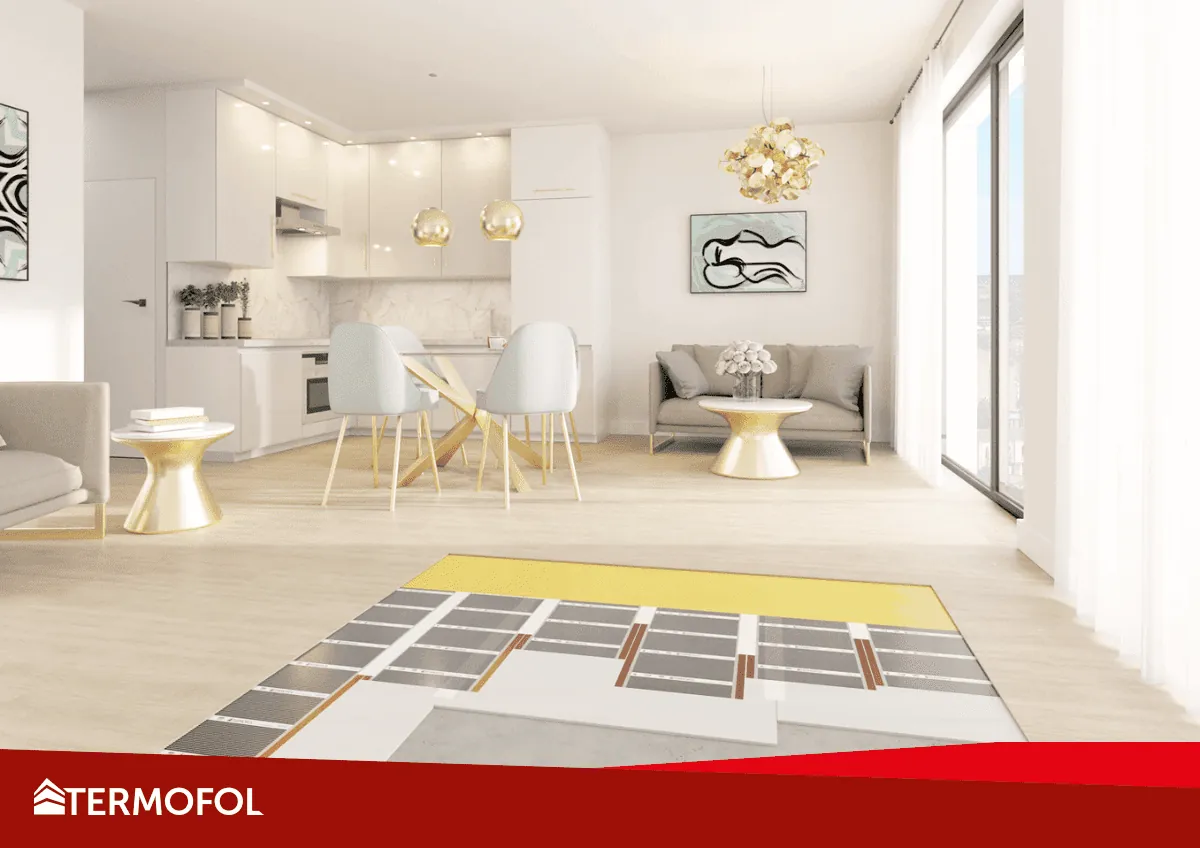
 General information